Soudan : des familles ayant fui El Fasher racontent la violence et leurs conditions de vie insoutenables
Après des mois de violents combats, des milliers de familles fuient la ville d’El Fasher depuis plusieurs semaines et se réfugient à Tawila, où elles arrivent épuisées, affamées et démunies. Les équipes du Comité international de la Croix-Rouge (CICR) qui leur viennent en aide indiquent que leur nombre ne cesse d’augmenter chaque jour, la violence, le manque de nourriture et l’effondrement des services de santé poussant toujours plus de civils à fuir.
Les personnes qui arrivent d’El Fasher racontent les attaques et les scènes de panique dont elles ont été témoins tandis qu’elles quittaient la ville. Jamila Ismail, une mère de sept enfants, explique avoir désespérément cherché son fils Ibrahim à la suite d’une attaque au cœur d’un marché local : « Je craignais qu’il ait été tué », raconte-t-elle. « Je l’ai cherché parmi les corps. Il y avait des cadavres partout. Le chaos régnait. C’était horrible. Des blessés gémissaient et appelaient à l’aide, mais personne ne leur prêtait attention. Chacun s’occupait en priorité des personnes qu’il connaissait. J’ai continué à chercher mon fils. En vain. »
Elle l’a finalement retrouvé, en vie mais gravement blessé. Il avait été transporté dans l’une des rares structures médicales encore opérationnelles de la ville. Avec l’aide d’un voisin, Jamila et les siens ont réussi à quitter El Fasher. Ils ont trouvé refuge à Tawila, comme des milliers d’autres civils eux aussi confrontés à la mort, à la violence et à l’angoisse d’être sans nouvelles de leurs proches.
Tawila est rapidement devenue l’épicentre de la réponse humanitaire dans l’État du Darfour Nord, les camps de fortune de la ville absorbant chaque jour des centaines de nouveaux arrivants originaires d’El Fasher. Les conditions de vie à Tawila sont très difficiles : s’approvisionner en eau et en nourriture, trouver un abri, se soigner est un combat quotidien pour les familles.
Hussein Ibrahim Rasool, coordinateur adjoint « sécurité économique » du CICR au Soudan, témoigne de l’ampleur de la crise : « Des milliers de familles ont été contraintes d’abandonner leur foyer à cause du conflit. Elles ont trouvé refuge ici, à Tawila, et d’autres continuent d’affluer chaque jour. Il s’agit essentiellement de femmes, d’enfants et de personnes âgées. Toutes ces personnes sont en situation d’extrême vulnérabilité, dans l’impossibilité de subvenir à leurs besoins essentiels. Elles sont affamées, déshydratées, traumatisées et épuisées. Certaines sont blessées ou malades, et n’ont parfois plus de nouvelles de leurs proches. »
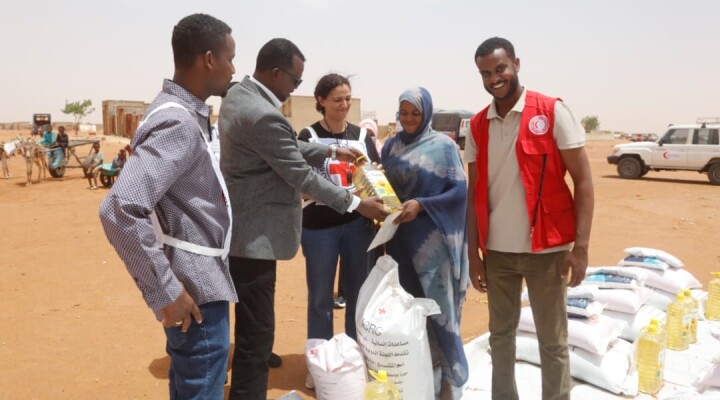
À Tawila, le CICR a intensifié ses activités humanitaires afin de répondre aux besoins essentiels des communautés affectées. En coopération avec le Croissant-Rouge soudanais, les équipes du CICR ont déjà fourni une aide financière à 10 000 familles déplacées – soit près de 60 000 personnes au total – et renforcent actuellement l’assistance destinée aux nouveaux arrivants de manière à venir en aide à 12 000 ménages supplémentaires – soit environ 72 000 personnes.
Cette assistance consiste également à fournir des articles médicaux essentiels et une aide opérationnelle à l’hôpital soutenu par MSF ainsi qu’aux centres médicaux des environs (matériel de pansement, incitations financières et contributions aux coûts de fonctionnement).
Le CICR a enregistré près de 7000 cas de disparition dans le cadre du conflit en cours au Soudan. Avec l’aide du Croissant-Rouge soudanais, il a facilité des centaines d’appels téléphoniques entre des familles réfugiées à Tawila et leurs proches, les aidant ainsi à maintenir le contact.
Length: 08:11
Location: Tawila, North Darfur state, Sudan
Date Of Filming: 8th - 13th November 2025
Copyright: ICRC access all
On Screen Credit: ICRC written or logo
00:00 - 00:50
Various shots of the Tawila camp, North Darfur state.
SOUNDBITE Jamila Ismail, Displaced in Tawila
00:50 – 00:53
I came from Al Fasher. I have a wounded child.
00:53 – 00:55
I have seven children, and one of them is missing.
00:55 – 01:01
I had a brother who was standing with us. He was killed during the shelling. The shell hit him at home.
01:01 – 01:03
After that, we left. It was just the four of us — women only.
01:03 – 01:08
This is how we’re living now. Our mother is a widow. She’s at home — she’s frail, and her eyesight is weak.
01:08 – 01:11
My son was injured. I wasn’t home, I was at the market.
01:11 – 01:13
I was hiding in the bunker in the market area.
01:13 – 01:18
I thought he might have been killed. I searched for him among the dead at the market. Bodies were scattered everywhere.
01:18 – 01:28
The situation at the market was chaotic and heartbreaking. Some of the wounded received no help. Some were crying, begging to be treated, but no one would help them — everyone was busy treating the ones they knew.
01:28 – 01:33
I kept looking for my son, hoping I would find him. But I couldn’t. Wherever I asked, they told me he might be among the dead.
01:33 – 01:40
I checked dead bodies. It’s a very strange feeling — very unnatural — when you have someone missing.
01:40 – 01:43
We’ve grown used to assuming that if someone doesn’t come back, they’re probably dead.
01:43 – 01:49
I asked someone, “Is my son Ibrahim okay?”
01:49 – 01:52
He said, “To be honest, Ibrahim is alive, but he’s injured. He underwent surgery, and it was successful.”
01:52 – 01:57
No one thought he would survive, because he was wounded in the lungs and the stomach.
01:57 – 02:01
I called my neighbor. He was kind enough to send me some money.
02:01 – 02:08
A driver brought us here. After that, we reached Tawila.
02:08 – 02:13
But our situation here is terrible. We don’t have blankets. He uses bed sheets as covers.
02:13 – 02:19
As for the rest of the kids, we dismantle this shelter at night, use it as covers, and reassemble it in the morning for shade.
02:19 – 02:24
As for food, we don’t have any. We wait for those who have to share with us.
02:24 – 02:29
Otherwise, we have nothing — nor anyone abroad to send us help.
02:29 – 02:37
Shot of Jamila Ismail walking in the camp.
02:37 – 02:46
Shot of Jamila’s son showing his injuries.
02:46 – 03:09
Various shots of Jamila with her family.
SOUNDBITE Rasha Ahmed, Displaced in Tawila
03:09 – 03:13
We were staying in Al-Takaful neighborhood when a shell hit.
03:13 – 03:15
My husband went missing.
03:15 – 03:21
And I was injured in my ear. Right now it doesn’t let me sleep at all.
03:21 – 03:26
During the day I’m fine, but at night it hurts. You can see it — a part of it was chopped off.
03:26 – 03:35
At the beginning we tried to flee, but there was no transportation. We stayed until Al Fasher calmed down, then we managed to escape.
03:35 – 03:40
Right now we have no one to take care of us except my mother and brother.
03:40 – 03:47
I have arrived heavily pregnant, and I don’t have anything to help me after giving birth — nothing for my postpartum period. Just patience and waiting.
03:47 – 03:51
There was food in Al Fasher at the beginning,
03:51 – 03:54
but because of the war we started running out of supplies.
03:54 – 03:58
People started eating umbaz (animal feed). There was nothing left.
03:58 – 04:05
Other than Wad El-Rufa’ee’s community kitchen, no one was feeding people in the entire city of Al Fasher.
04:05 – 04:12
They took all our belongings. Everything was thrown into the streets. They didn’t allow us to take anything — not even bed sheets or covers.
04:12 – 04:17
My mother gave me her covers. I use them to cover my kids — they can’t stand the cold.
04:17 – 04:30
Right now, I am eight months pregnant. No one provides for me… I’m just waiting.
04:30 – 05:12
Various shots of people in the camp.
SOUNDBITE Hussein RASOOL, Deputy Economic Security Coordinator, ICRC
05:12 – 05:18
Thousands of families have been forced to flee their homes as a result of the conflict.
05:18 – 05:26
They have arrived here in Tawila, and they are arriving on a daily basis. They are mostly women, children and elderlies.
05:26 – 05:38
Their situation is extremely difficult. They are even not able to cover their basic needs. They are hungry, thirsty, traumatized and exhausted.
05:38 – 05:43
Some of them are even injured or sick and have lost contact with their beloved ones.
05:43 – 05:59
The rapid response teams of the International Committee of the Red Cross and Sudanese Red Crescent Society are working tirelessly on the ground on a daily basis, trying to bring relief and hope to those affected communities.”
05:59 – 06:49
Various shots from the cash assistance distribution in the camp.
SOUNDBITE Um Salama, Displaced in Tawila
06:49 – 06:53
We came from Al Fasher to Tawila camp.
06:53 – 06:56
We faced troubles on the way.
06:56 – 07:04
We ran into those criminals. We faced beating, burning, rape, and other things.
07:04 – 07:14
And now we are here in Tawila camp in Argo area. We thank God for reaching here after suffering from hunger and thirst.
07:14 – 07:22
We are very grateful to God that we received cash support.07:22 – 07:41
Various shots of Restoring Family Links activity by ICRC with SRCS in Tawila in October 2025.
07:41 – 08:11
Various shots of ICRC Mobile Surgical Team with MSF crew operating on a war-wounded patient.