Sudan: Families fleeing Al-Fasher recount harrowing violence, face dire needs
After months of heavy fighting, thousands of families have escaped the Sudanese city of Al Fasher in recent weeks and reached the city of Tawila – exhausted, hungry and with almost no belongings. Teams from the International Committee of the Red Cross (ICRC) assisting new arrivals say the flow is increasing daily, as civilians flee violence, food shortages and the collapse of medical services.
Those who fled Al Fasher described attacks and scenes of panic as they left the city. Jamila Ismail, a mother of seven, recalled desperately searching for her son after a local market was attacked: “I thought he might have been killed,” she said. “I searched for him among the dead at the market. Bodies were scattered everywhere. The situation at the market was chaotic and heartbreaking. Some were crying, begging to be treated, but no one would help them. Everyone was busy treating the ones they knew. I kept looking for my son, hoping I would find him. But I couldn’t.”
She eventually found her son Ibrahim, alive but severely wounded. He had been taken to one of the few medical structures still functioning in the city. With the support of a neighbour, Jamila and her family managed to flee Al Fasher. They are now in Tawila, joining thousands of others who recount similar stories of death, abuse and losing touch with their loved ones.
Tawila has rapidly become the epicentre of the humanitarian response in North Darfur, with makeshift camps absorbing hundreds of displaced civilians from Al Fasher every day. Conditions in Tawila are dire, with families struggling to access food, water, shelter and medical care.
Hussein Ibrahim Rasool, the ICRC's deputy economic security coordinator in Sudan, described the scale of the crisis and explained the ongoing response. “Thousands of families have been forced to flee their homes as a result of the conflict. They have arrived here in Tawila, and they are arriving on a daily basis. They are mostly women, children and the elderly. Their situation is extremely difficult. They are not even able to cover their basic needs. They are hungry, thirsty, traumatized and exhausted. Some of them are even injured or sick and lost the contact with their beloved ones.”
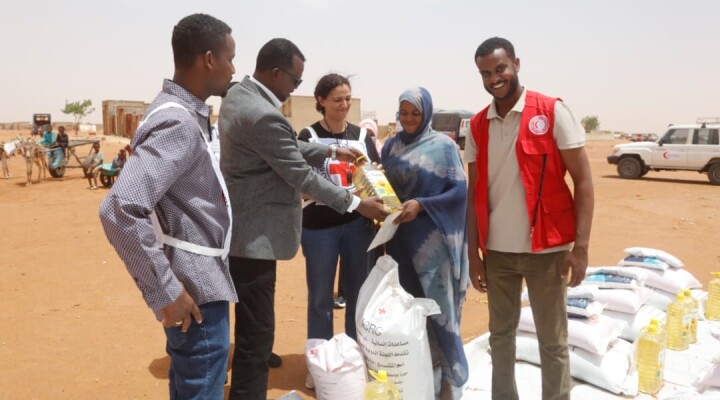
In Tawila, the ICRC has scaled up its humanitarian response to meet the critical needs of the affected communities. Together with the Sudanese Red Crescent Society (SRCS), ICRC teams have already provided financial assistance to 10,000 families – around 60,000 displaced people – and are increasing assistance for newly arrived families, which will cover an additional 12,000 households – around 72,000 people.
This support also includes delivering essential medical supplies and operational assistance to the MSF-supported hospital and nearby medical points in the form of dressing materials, staff incentives and contributions to running costs.
The ICRC has registered approximately 7,000 missing persons in total in relation to the conflict in Sudan. The ICRC and SRCS have facilitated hundreds of phone calls in Tawila to help families stay connected with their loved ones.
Length: 08:11
Location: Tawila, North Darfur state, Sudan
Date Of Filming: 8th - 13th November 2025
Copyright: ICRC access all
On Screen Credit: ICRC written or logo
00:00 - 00:50
Various shots of the Tawila camp, North Darfur state.
SOUNDBITE Jamila Ismail, Displaced in Tawila
00:50 – 00:53
I came from Al Fasher. I have a wounded child.
00:53 – 00:55
I have seven children, and one of them is missing.
00:55 – 01:01
I had a brother who was standing with us. He was killed during the shelling. The shell hit him at home.
01:01 – 01:03
After that, we left. It was just the four of us — women only.
01:03 – 01:08
This is how we’re living now. Our mother is a widow. She’s at home — she’s frail, and her eyesight is weak.
01:08 – 01:11
My son was injured. I wasn’t home, I was at the market.
01:11 – 01:13
I was hiding in the bunker in the market area.
01:13 – 01:18
I thought he might have been killed. I searched for him among the dead at the market. Bodies were scattered everywhere.
01:18 – 01:28
The situation at the market was chaotic and heartbreaking. Some of the wounded received no help. Some were crying, begging to be treated, but no one would help them — everyone was busy treating the ones they knew.
01:28 – 01:33
I kept looking for my son, hoping I would find him. But I couldn’t. Wherever I asked, they told me he might be among the dead.
01:33 – 01:40
I checked dead bodies. It’s a very strange feeling — very unnatural — when you have someone missing.
01:40 – 01:43
We’ve grown used to assuming that if someone doesn’t come back, they’re probably dead.
01:43 – 01:49
I asked someone, “Is my son Ibrahim okay?”
01:49 – 01:52
He said, “To be honest, Ibrahim is alive, but he’s injured. He underwent surgery, and it was successful.”
01:52 – 01:57
No one thought he would survive, because he was wounded in the lungs and the stomach.
01:57 – 02:01
I called my neighbor. He was kind enough to send me some money.
02:01 – 02:08
A driver brought us here. After that, we reached Tawila.
02:08 – 02:13
But our situation here is terrible. We don’t have blankets. He uses bed sheets as covers.
02:13 – 02:19
As for the rest of the kids, we dismantle this shelter at night, use it as covers, and reassemble it in the morning for shade.
02:19 – 02:24
As for food, we don’t have any. We wait for those who have to share with us.
02:24 – 02:29
Otherwise, we have nothing — nor anyone abroad to send us help.
02:29 – 02:37
Shot of Jamila Ismail walking in the camp.
02:37 – 02:46
Shot of Jamila’s son showing his injuries.
02:46 – 03:09
Various shots of Jamila with her family.
SOUNDBITE Rasha Ahmed, Displaced in Tawila
03:09 – 03:13
We were staying in Al-Takaful neighborhood when a shell hit.
03:13 – 03:15
My husband went missing.
03:15 – 03:21
And I was injured in my ear. Right now it doesn’t let me sleep at all.
03:21 – 03:26
During the day I’m fine, but at night it hurts. You can see it — a part of it was chopped off.
03:26 – 03:35
At the beginning we tried to flee, but there was no transportation. We stayed until Al Fasher calmed down, then we managed to escape.
03:35 – 03:40
Right now we have no one to take care of us except my mother and brother.
03:40 – 03:47
I have arrived heavily pregnant, and I don’t have anything to help me after giving birth — nothing for my postpartum period. Just patience and waiting.
03:47 – 03:51
There was food in Al Fasher at the beginning,
03:51 – 03:54
but because of the war we started running out of supplies.
03:54 – 03:58
People started eating umbaz (animal feed). There was nothing left.
03:58 – 04:05
Other than Wad El-Rufa’ee’s community kitchen, no one was feeding people in the entire city of Al Fasher.
04:05 – 04:12
They took all our belongings. Everything was thrown into the streets. They didn’t allow us to take anything — not even bed sheets or covers.
04:12 – 04:17
My mother gave me her covers. I use them to cover my kids — they can’t stand the cold.
04:17 – 04:30
Right now, I am eight months pregnant. No one provides for me… I’m just waiting.
04:30 – 05:12
Various shots of people in the camp.
SOUNDBITE Hussein RASOOL, Deputy Economic Security Coordinator, ICRC
05:12 – 05:18
Thousands of families have been forced to flee their homes as a result of the conflict.
05:18 – 05:26
They have arrived here in Tawila, and they are arriving on a daily basis. They are mostly women, children and elderlies.
05:26 – 05:38
Their situation is extremely difficult. They are even not able to cover their basic needs. They are hungry, thirsty, traumatized and exhausted.
05:38 – 05:43
Some of them are even injured or sick and have lost contact with their beloved ones.
05:43 – 05:59
The rapid response teams of the International Committee of the Red Cross and Sudanese Red Crescent Society are working tirelessly on the ground on a daily basis, trying to bring relief and hope to those affected communities.”
05:59 – 06:49
Various shots from the cash assistance distribution in the camp.
SOUNDBITE Um Salama, Displaced in Tawila
06:49 – 06:53
We came from Al Fasher to Tawila camp.
06:53 – 06:56
We faced troubles on the way.
06:56 – 07:04
We ran into those criminals. We faced beating, burning, rape, and other things.
07:04 – 07:14
And now we are here in Tawila camp in Argo area. We thank God for reaching here after suffering from hunger and thirst.
07:14 – 07:22
We are very grateful to God that we received cash support.
07:22 – 07:41
Various shots of Restoring Family Links activity by ICRC with SRCS in Tawila in October 2025.
07:41 – 08:11
Various shots of ICRC Mobile Surgical Team with MSF crew operating on a war-wounded patient.
For further information, please contact:
- Adnan Hezam, Port Sudan, Mobile: +249912150735, ahizam@icrc.org
- Eléonore Asomani, Dakar, Mobile: +221781864687, easomani@icrc.org
On the ground in 100 countries, the International Committee of the Red Cross has one humanitarian mission: to promote respect for the laws of war, international humanitarian law and help people caught up in armed conflicts and violence.